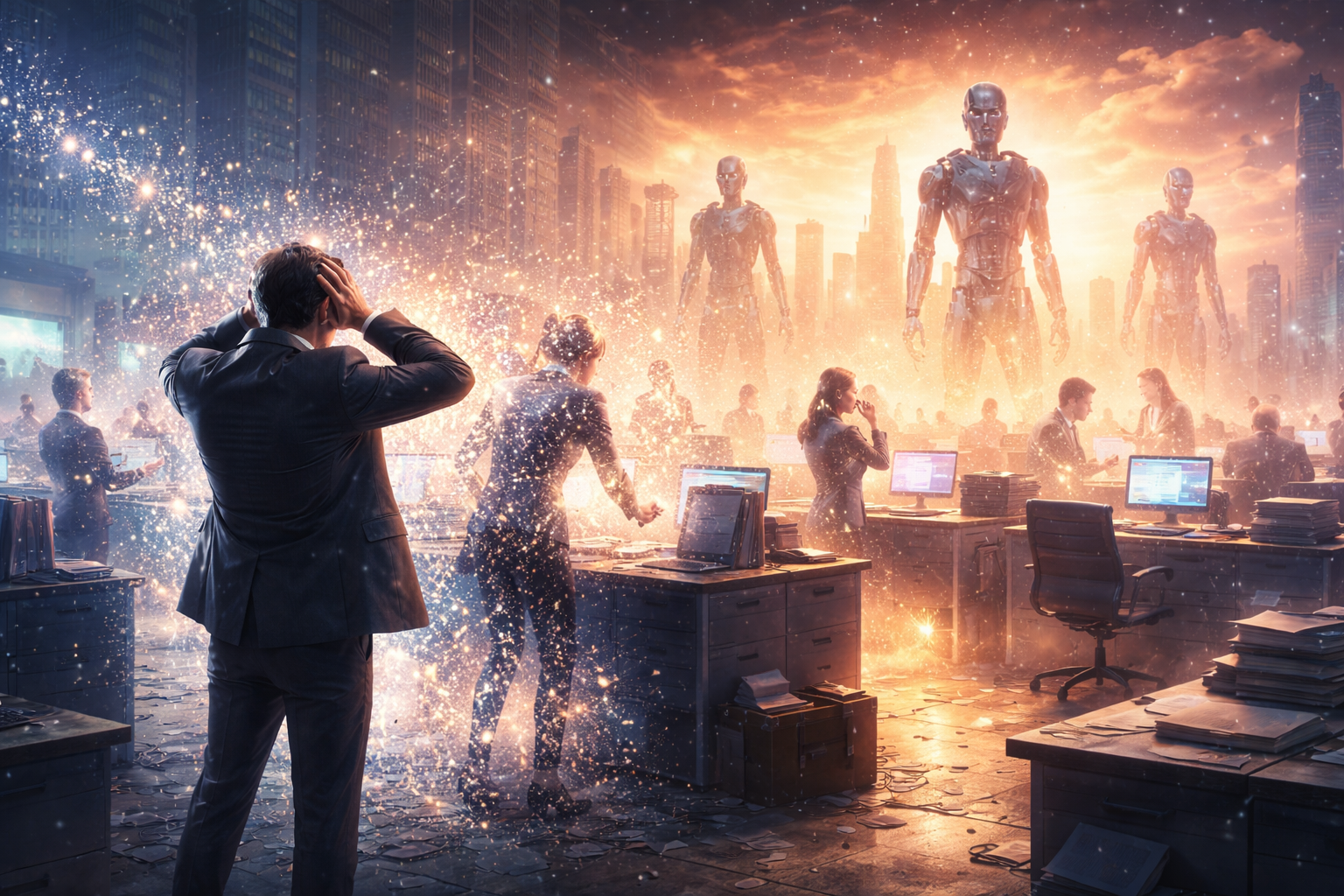
When AI first started to emerge in public consciousness, I wasn’t very excited. I was honestly a bit scared.
The idea of such a powerful technology—something that could potentially outperform the cognitive strengths of Homo sapiens—felt unsettling. How could this not go wrong? Wouldn’t this eventually mean the end of humanity as we know it?
My mind immediately went to all the familiar doom scenarios. Massive job loss. Entire professions becoming obsolete. Technology gaining more and more control over our lives. Less autonomy, more surveillance, more dependency. I wondered: What if this technology grows faster than our ability to guide it consciously? For a while, those thoughts dominated my perspective. Until I started to look deeper.
Questioning the fear
The more I learned about AI—how it works, where it’s already being used, and how deeply human intention shapes it—the more my initial fear began to soften. Not because the risks disappeared, but because the story became more nuanced.
I started to ask myself a different question: Is AI really the problem? Or is it exposing something that was already out of balance?
That question changed everything.
How human is our current way of living?
When I zoomed out and looked at modern life, something became painfully clear. Many people are already exhausted, disconnected, and unfulfilled—long before AI entered the picture. Burn-outs are rising. Loneliness is increasing. A lot of people don’t feel a deep sense of meaning in their work. There is constant pressure to perform, to produce, to keep up.
For many, daily life looks like this: Long workweeks. Sitting behind screens all day. Artificial lighting. Traffic jams that eat up hours. Coming home only to start the next round of tasks—cooking, cleaning, managing life.
And the irony is hard to ignore: Much of this work is already repetitive and mentally draining.
So I began to wonder: How human is our lifestyle, really? And what does it actually mean to be human?
What makes us human
When you strip it down, being human isn’t about efficiency or output. It’s about: connection, empathy, love, creativity, curiosity, play, community and presence. It’s about having the space to feel, to reflect, to relate—to ourselves and to each other. And that’s where my perspective on AI shifted completely.
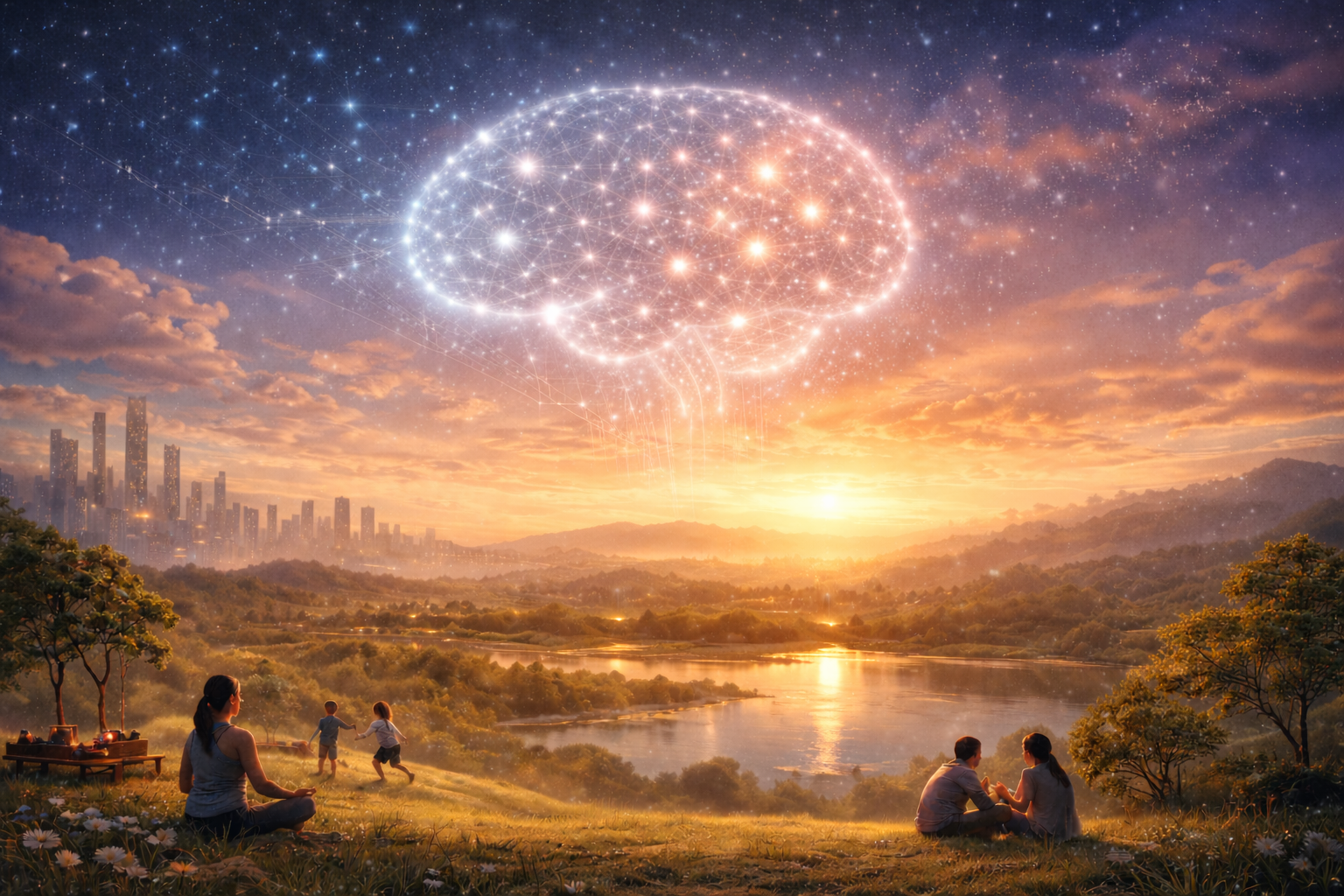
What if AI could take over the most repetitive and computer tasks—so we don’t have to live like robots ourselves anymore?
What if technology could create space instead of consuming it?
Space for more meaningful work.
Space for deeper relationships.
Space for creativity, rest, and purpose.
A crucial moment in time
I understand why this sounds utopian to some. AI can absolutely be used in harmful ways—more control, more power concentration, more invasion of privacy. Those risks are real and shouldn’t be ignored. But technology itself is not inherently good or bad. It amplifies intention.
AI is already here and its influence will only continue to grow. Over the coming years, it will play an increasingly dominant role in how we work, communicate, create, and organize society. The real question is not whether AI will shape our future—but how consciously we choose to engage with it.
We are standing at an important turning point as a humanity. The decisions we make in the near future—about how AI is designed, regulated, and used in everyday life—will have a lasting impact on the kind of society we are shaping. The coming years are crucial. They will help determine whether AI reinforces systems driven by control and efficiency alone, or whether it supports a more humane, balanced way of living.
As a society, we are being invited to revisit some fundamental questions: How do we want to work? What do we truly value? Where do we place our time, energy, and attention? And what kind of future do we want to create together? As AI becomes more embedded in our lives, conscious choice becomes increasingly important.
Consciousness as the missing piece
What I keep coming back to is this: consciousness will be decisive in the role AI plays in our lives.
Technology itself is powerful, but directionless. It takes shape through the awareness, values, and intentions of the people who design and use it. When we engage with AI unconsciously—driven by speed, fear, or pure efficiency—it can easily pull us further away from ourselves. But when we use it deliberately, something else becomes possible.
By choosing to work with technology consciously, we can actively shape a future that feels more aligned with our nature. One where innovation doesn’t override our humanity, but supports it. Where progress isn’t measured only in output, but in well-being, connection and meaning.
In that sense, AI isn’t just a technological development—it’s an invitation to expand consciousness. An invitation to grow in awareness. To make wiser choices. And to come back into closer relationship with what it means to be human.
The intention behind Super Natural Solutions
That belief is why I started Super Natural Solutions. This platform isn’t about glorifying technology or dismissing valid concerns. It’s about offering a different narrative—one where AI is used consciously, ethically and in alignment with our human nature.
This platform will share reflections, insights, and projects that align with this vision—initiatives that show it is possible to integrate technology without losing our soul, but instead supporting us in remembering it.