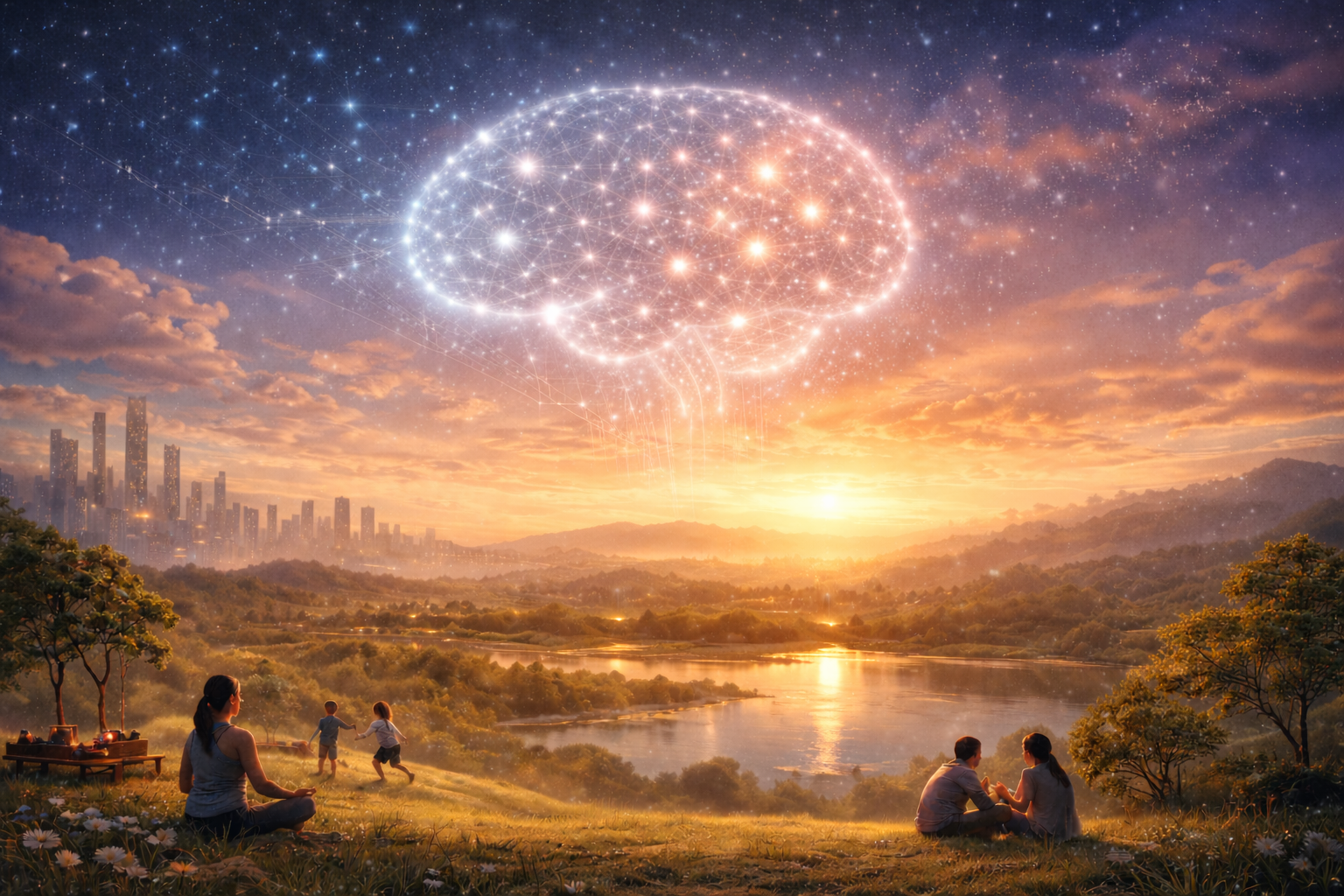
And why that might be exactly what humanity needs
A large part of our economy—roughly 70 to 80 percent—is built on what we call hard skills. Skills that can be defined by rules, processes, and logic. Tasks that can be written down, standardized, and repeated.
Think of working with spreadsheets all day.
Cold-calling for sales.
Writing website copy.
Analyzing legal documents.
Diagnosing based on data patterns.
These activities may feel “intellectual,” but at their core they are repetitive and rule-based. And that’s exactly where artificial intelligence excels.
Our entire education system is largely designed around developing these hard skills. We train people to become lawyers, doctors, consultants, analysts—roles that rely heavily on cognitive performance. Intelligence, efficiency, and mental capacity have become the main measure of success in modern society.
And now AI enters the picture.
AI and the automation of hard skills
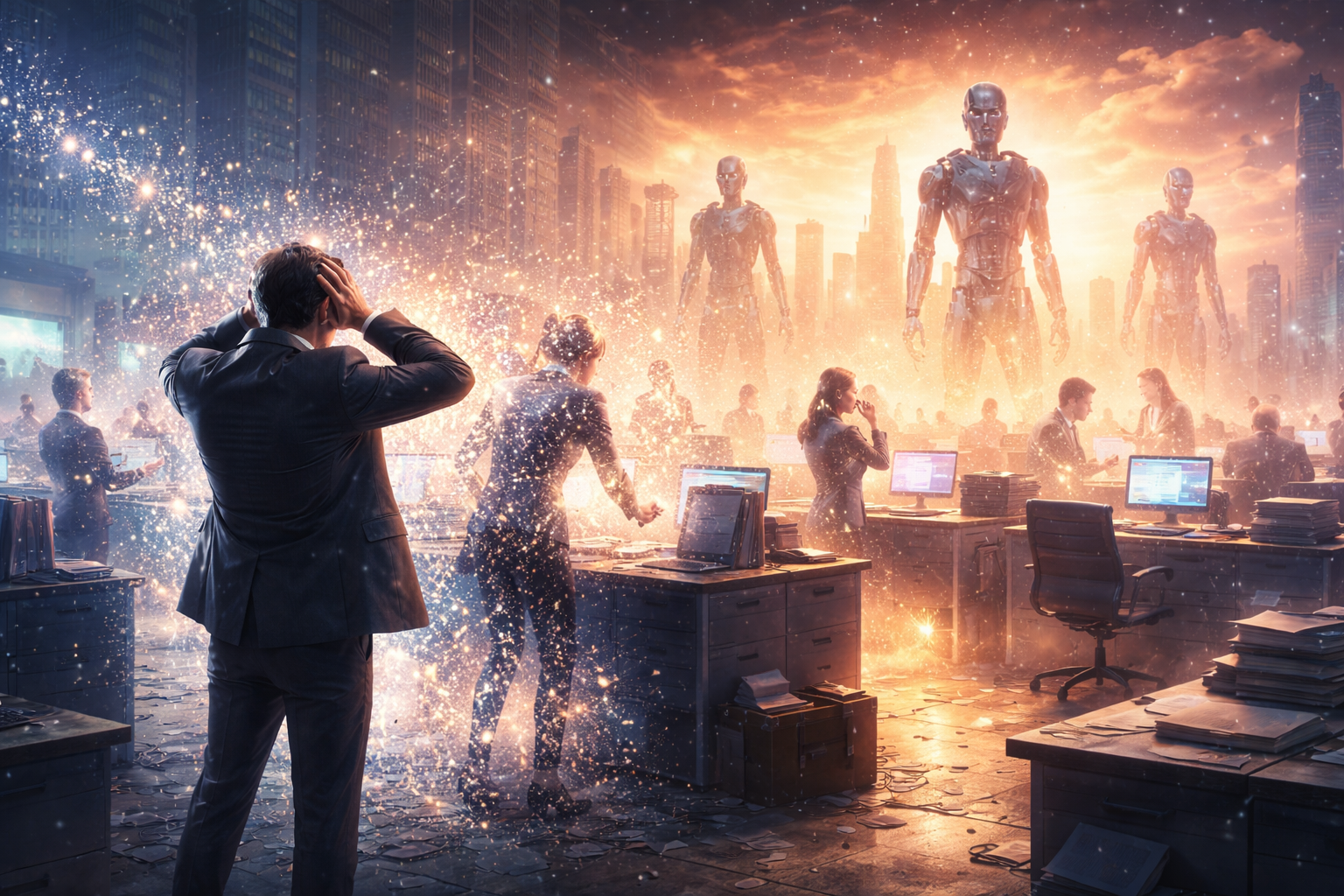
What we are witnessing—within an incredibly short time span—is that AI is starting to outperform humans at many of these hard skills. Faster. Cheaper. More consistent. Often more accurate.
AI can already write legal documents, analyze contracts, make medical diagnoses, generate marketing strategies and optimize financial models. And this is only the beginning.
This doesn’t mean all jobs will disappear overnight. But it does mean that the roles that are most cognitive, most rule-based, and most status-driven are likely to be hit the hardest.
Which confronts us with an uncomfortable question:
If machines can do what we were trained to do—what does that leave us with?
What machines cannot do
There is a crucial distinction that often gets overlooked.
AI is extremely cognitive.
Humans are not only cognitive.
Machines cannot truly embody:
-
empathy
-
compassion
-
ethics
-
emotional intelligence
-
respect
-
deep presence
-
authentic relationships
-
the ability to feel
These are not “soft” in the sense of being weak. They are deeply human. And they cannot be automated.
For a long time, these qualities were undervalued—or even subtly punished. Being sensitive, intuitive, emotional, or purpose-driven didn’t fit well into productivity metrics or corporate hierarchies.
So we adapted.
We moved into our heads.
We learned to perform.
We became very good at acting like machines.
And now actual machines are taking over that role.
From human doings to human beings
This shift may trigger something much bigger than an economic transition. It may trigger an identity crisis.
For decades, many of us have unconsciously lived by the idea: you are what you do. Your job title, income and status became part of your identity.
But what happens when AI can do your job—often better, faster, and for free?
What happens to your sense of worth if your role as “lawyer,” “doctor,” or “expert” is no longer rare?
We may be forced to confront a deeper truth:
We were never meant to define ourselves solely by what we produce.
We are moving—from human doings to human beings.
A multidimensional crisis
This transition won’t be easy. We are likely heading into a multidimensional crisis:
Jobs will change.
Income structures will be challenged.
Our monetary system may be redefined.
And that touches one of the deepest human drivers: security.
Money. Survival. Safety. Stability.
It’s understandable that fear arises here.
But there is another way to look at what’s unfolding.
Technology acts like a mirror. It reflects where we’ve over-identified with the mind, productivity, external validation—and neglected our inner world. The parts of us that were always there, but rarely given space.
We were born as empathic, creative, relational beings. Yet our systems trained us away from that. Now, paradoxically, technology is pushing us back toward it.
Becoming more human, not less
AI isn’t just replacing tasks.
It’s challenging the very foundation of how we define value, success, and identity.
It is quietly asking:
Who are you, beyond your job?
What do you stand for?
What do you want to bring into the world?
What is your deeper purpose?
In that sense, AI isn’t taking humanity away from us.
It’s forcing us to reclaim it.
The only real way forward may be alignment—not with external expectations, but with who we truly are. With our values. Our sense of meaning. Our inner compass.
Because in a world where machines handle the mechanical, our humanity becomes our greatest contribution.
And perhaps that was the point all along.